Stories / 21 September 2026
Trip to See the Total Solar Eclipse in Exmouth, Western Australia — April 2023
Sixty-two seconds of totality at Ningaloo, Western Australia — our first total solar eclipse, on 20 April 2023, after seven months of planning and 9,000km of travel.
Our eclipse day experience on 20th April 2023, when we saw our first total solar eclipse.
We entered the beach at 10:00am, just four minutes before C1 — first contact (start of the eclipse). Hurrying to set up our tripods on a sandy patch by the sea, we started taking our first shots just as the Moon’s disc started entering the Sun. The hybrid eclipse had officially begun.
Once we were satisfied with having captured C1, we started the long process of setting up all our mounts, tripods, and cameras. We had a total of ten cameras between us, each with a specific purpose that we had planned for in advance.
Soon, the beach had reached capacity of ~200 people as the Moon continued to cover the Sun, and we periodically checked with our eclipse glasses as the Sun’s visible area grew smaller and smaller.
The morning had started out hot and sunny, but as the eclipse progressed, all of us noticed the temperature drop, and the intensity of sunlight growing visibly less.
An “Eclipse Timer” app on our phone was our timekeeper, calling out voice updates informing us of the time remaining to totality, amidst other phenomena happening around us.
We had finally finished setting up our equipment in around an hour, and around 20 minutes were left before C2 — second contact, the start of totality. Since this was a hybrid eclipse, the totality duration (when the Moon fully covers the Sun) was relatively short, at around 62 seconds.
Our observing site was right at the centerline of the path of the umbra (the dark part of the Moon’s shadow), enabling us to view the eclipse for as long as physically possible on mainland Australia.
The minutes ticked by astonishingly quickly, the sunlight fading to almost nothing as we checked and double-checked our camera settings, and our plan for totality.
This was it. Seven months of planning was going to come down to 62 seconds. 9,000km of travel would amount to nothing if anything went wrong at the last moment.
Since this was our first time seeing a total solar eclipse (which is extremely rare to see on Earth, often requiring extensive travel and years between opportunities), we had discussed beforehand that our priority would be to see it with our own eyes, in addition to photographing it.
This might seem strange considering we are all hardcore astrophotographers, but we knew that a chance like this wouldn’t come a second time in the near future, and we had read online from eclipse chasers that a total solar eclipse has a quality that cannot be expressed in any photograph. Even though we knew this going in, we were still unprepared for the sight we were about to witness.
At T-2 minutes, our app informed us of a phenomenon known as shadow bands. This is an extremely rare and hard-to-spot optical phenomenon where wavy, snake-like shadows race across the ground for a few seconds before and after totality. We had brought a white sheet to help us make out the faint shapes, and sure enough, we saw the eerie-looking shadow bands race across the sheet, even visible in the white sand.
We were so mesmerised by the shadow bands that, before we even knew what was happening, our app announced that totality was starting in twenty seconds, and we rushed to get our solar filters off our lenses. Photographing the Sun is extremely dangerous without the proper equipment, and a total solar eclipse is the only time it can be safely viewed and photographed without any specialised solar filters.
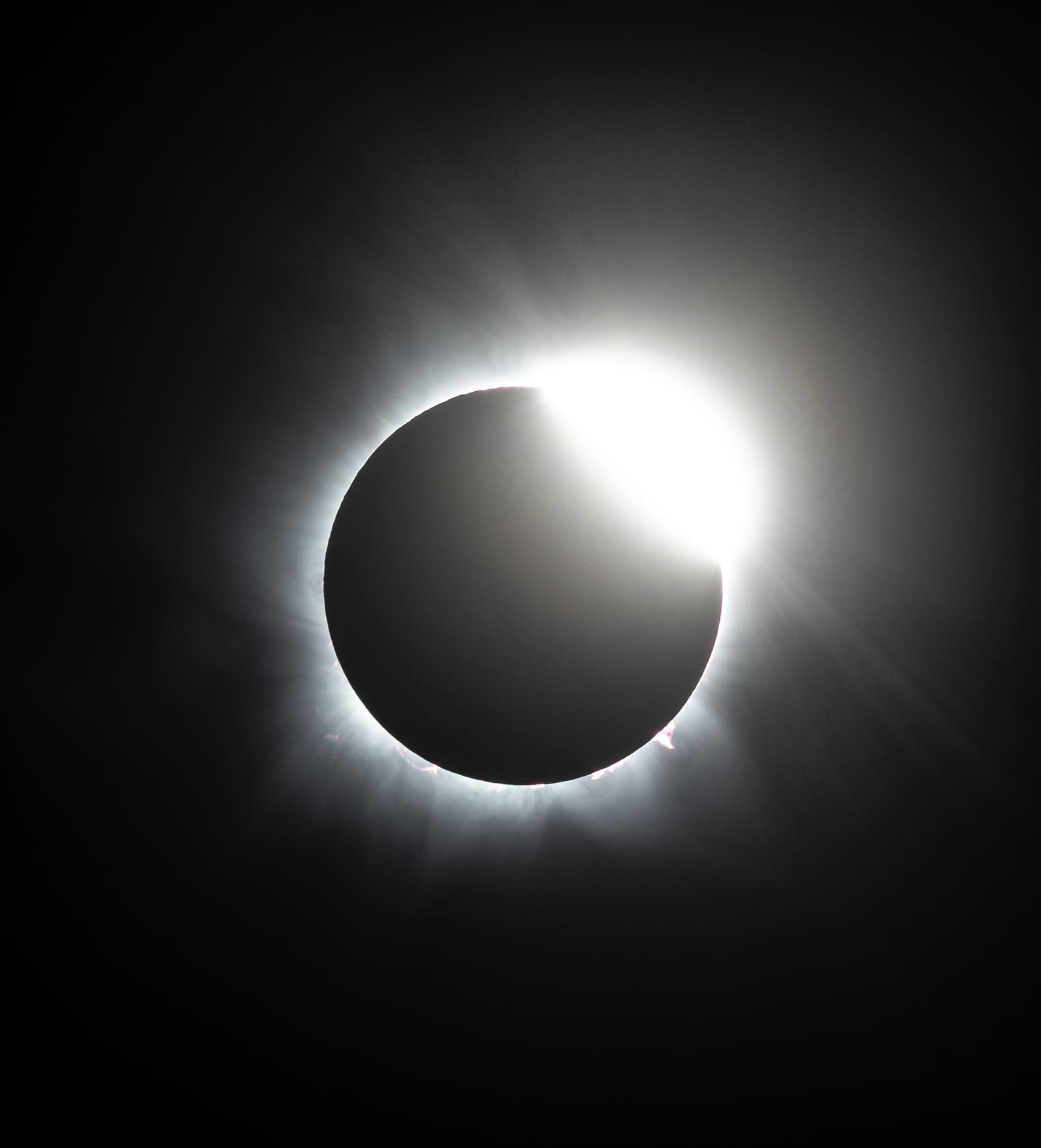
As our filters came off, our breaths collectively left our lungs. We saw the stunning black lunar disc silhouetted by the coronal streamers of the Sun’s atmosphere, the last of the Sun’s thin crescent shining bright, making a distinct image of a diamond ring. This is known as the “diamond ring effect.”
We had no time to admire it though, and we all pressed our shutter buttons repeatedly as the diamond ring broke up into small, bright points of light known as Baily’s beads. They are caused by the last wisps of sunlight passing through valleys on the lunar limb.
We pressed our shutters again, and in a matter of three or four seconds, even the last of that light was gone and we saw something that is so special, I’m lacking the vocabulary that’d do the sight justice.
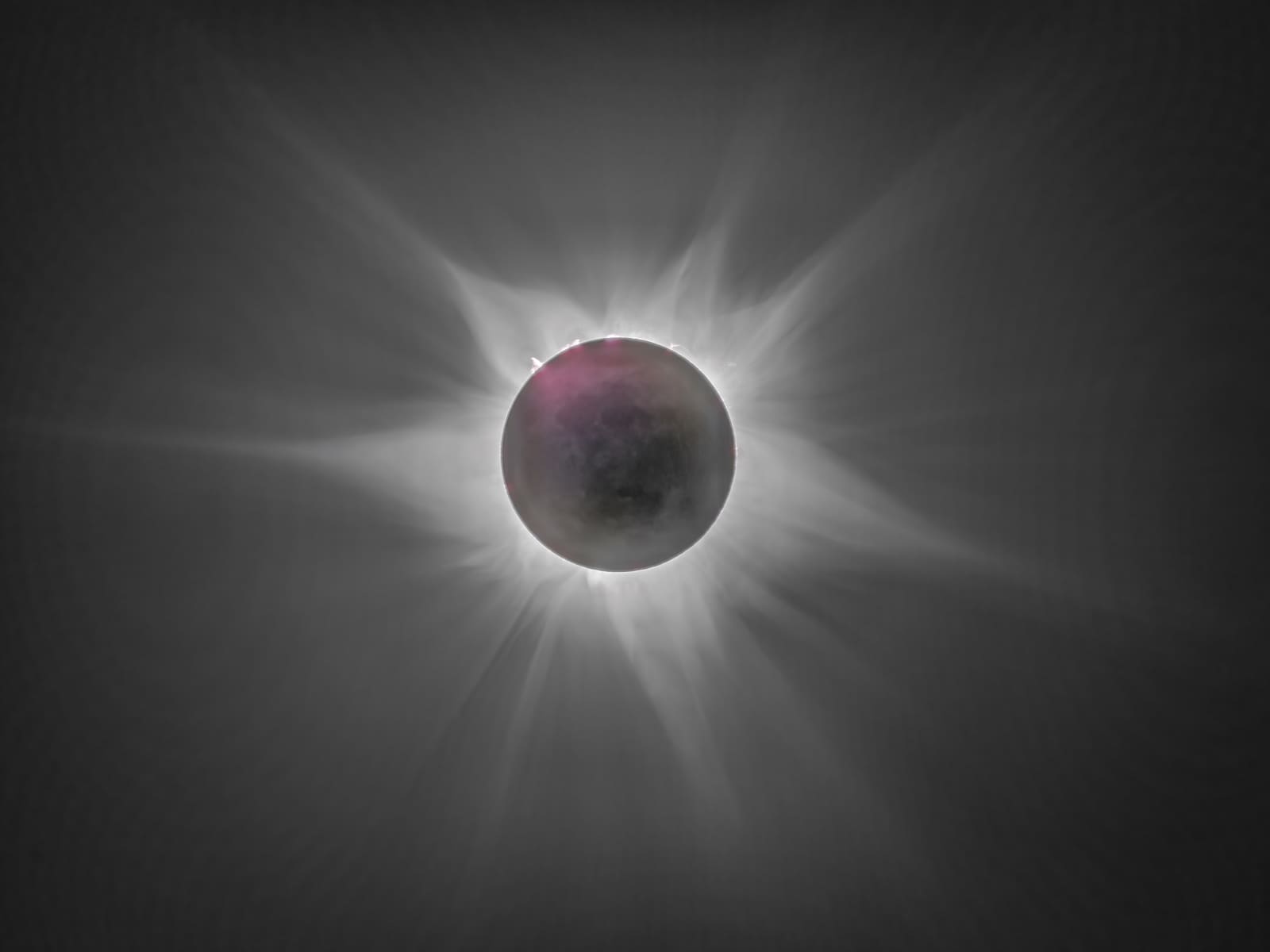
The pitch-black Moon, ringed by the Sun’s atmosphere, like a sunflower in the sky — as soon as we looked up from our cameras and at the sky, we instantly knew that we had done it. We had witnessed something less than a percent of all humans have ever witnessed.
In our excited state, we could only stare in awe, forcing ourselves to snap out of it and press the shutter buttons again. Only 45 seconds to go!
After the initial set of images was secured, we looked around at the gorgeous 360-degree sunset, at the stars and planets that were suddenly visible in the middle of the day, at the reactions of everyone around us.
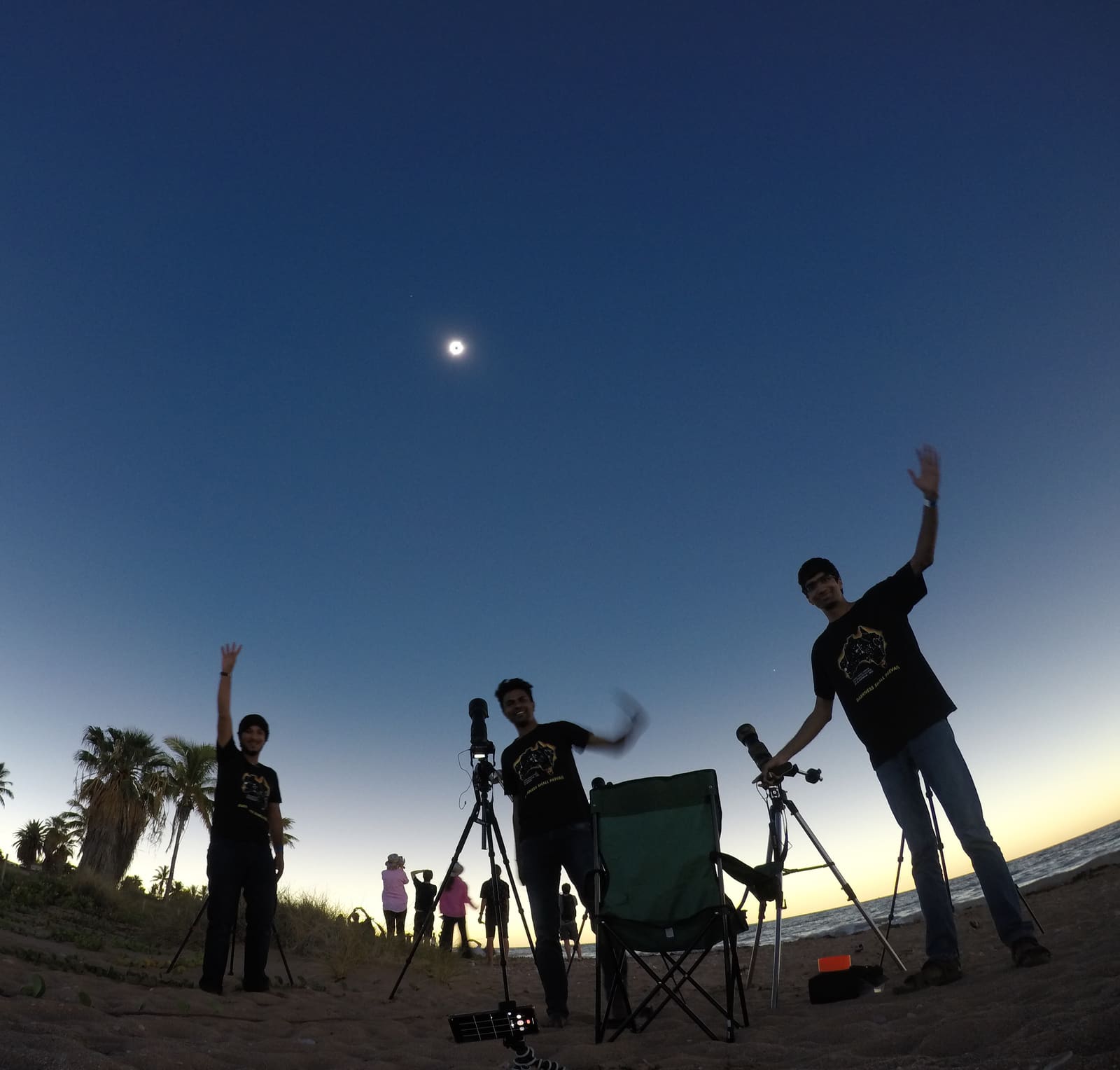
A few cheers were let out as we hit the midpoint at 31 seconds, and we remembered to turn around together and spend two or three precious seconds to pose for a photo that we will cherish for a long, long time.
The GoPro that we had set up on the ground captured us, hands raised and wide smiles on our faces, the totality high above us in the deep blue sky.
Even though it felt like it had barely begun, the app called out “ten seconds to C3 — third contact,” which would be the end of totality. We hurriedly finished more shots, hands on our solar filters that we had all but thrown on the sand below, right as the Sun peeked out from behind the Moon, and hence the longest and shortest minutes of our lives came to an end.
Taking some more shots of Baily’s beads and the diamond ring as it formed again on the other side, the Sun soon got too bright to safely image, and we popped our filters back on.
The second try to spot shadow bands was even more successful, and all three of us spotted them and captured them on video.
Once that was done, at around T+2 minutes, we realised that the totality-related phenomena were done, and we finally had a moment to breathe.
We looked at each other in awed surprise, not finding the words to express what we had seen. Each of us knew exactly what the other was thinking, but saying that in words wasn’t possible. A few excited “whooo!“s and giddy laughter followed, each of us expressing our disbelief.
Now we knew why a total solar eclipse is the most prized astronomical phenomenon, and why people travel around the world to chase it. Hardly a few minutes had passed and we were already talking about the next eclipse, which would happen in the USA in 2024 — which goes to show the impact it had had on us in such a short time.
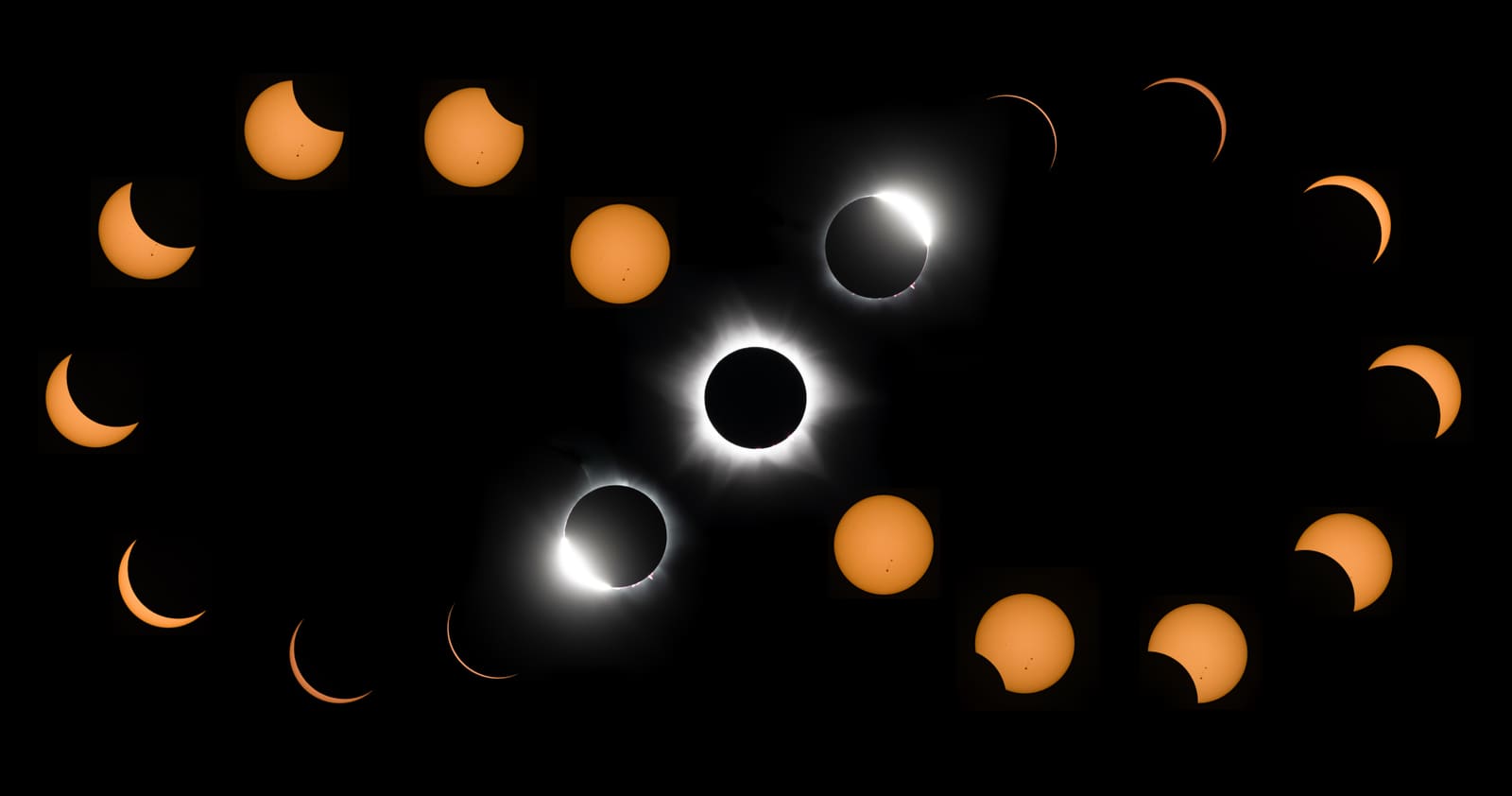
We continued taking images of the partial phases as the Moon continued on its orbit and left the solar disc, unaware of the small bunch of excited humans 300,000km away.
The temperature started rising again, and the cool breeze during the peak of the eclipse was replaced by hot sunlight.
It took a good hour for everything to sink in, and we excitedly reviewed the photos we had captured. Some huge pillars of plasma — prominences — were visible in our shots, an unexpected bonus that is usually uncommon, even in total eclipses.
Our images attracted fellow eclipse viewers, mostly Australians who had come to see the eclipse as a leisurely trip. They marvelled at our images and called their family members close, asking us to show the images again and again.
Satisfied with having achieved the primary goal of our trip, we gave our phone to a fellow eclipse watcher and posed with the Indian flag we had brought.
As representatives of the 140 crore Indians at this event, we made sure that an Indian contingent was among the eclipse chasers who had come here from all over the world — from the US, South America, Europe, Asia, and of course Australia.
We hope to travel to more total eclipses in the next decade, leading up to the only Indian total eclipse left in this century — 2034 in Kashmir. The journey has just begun!
—Shivam Bansal
Special thanks to Nihal S. Amin and Yash Soorma.